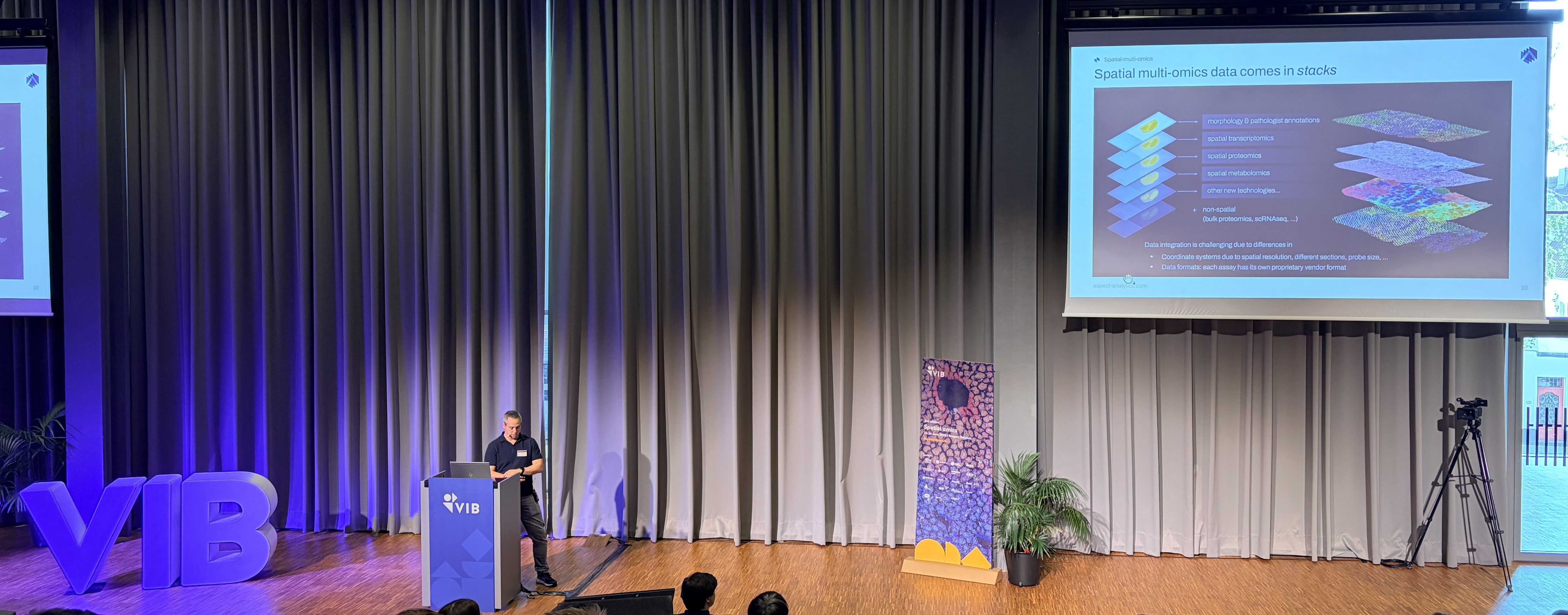

Wherever you are in your drug discovery or development pipeline, we help you turn spatial and multimodal data into clear, reproducible insights. Every solution in Weave helps you move from raw spatial data to clear biological interpretation, with standardized workflows you can reuse across cohorts and programs.
Weave® solutions that move your drug programs forward
Identify and confirm biological in spatial tissue context
Early discovery and validation depend on identifying real biological mechanisms and confirming they hold up across tissues and cohorts. Cellular behavior is shaped by tissue structure, spatial relationships, and cellular neighborhoods. Spatial context is the key to interpreting early signals and validating them with confidence.
Weave brings your spatial, molecular, and annotation data together so you can detect early biological patterns and validate them before committing to costly downstream work.
Identify spatial signatures linked to disease biology
Detect cellular neighborhoods and microenvironments driving phenotype
Increase confidence in findings through orthogonal, spatial multi-omics confirmation
Compare hypotheses across cohorts with reproducible workflows
Build structured, AI-ready datasets that accelerate downstream validation
Explain how interventions reshape tissue biology
You need to connect phenotype to mechanisms and understand how interventions reshape local tissue environments. Without spatial context, pathway shifts and cell-state transitions are hard to interpret, making mechanism-of-action claims difficult to defend.
Weave makes it easy to compare treated vs. control samples, map pathway changes, and see how cell-cell interactions and microenvironments shift.
Localize drug delivery down to the cellular level
Link molecular change to spatial structure
Map ligand–receptor communication and pathway activity
Quantify shifts in cell states and local microenvironments at multiple time points
Validate mechanisms with multimodal, spatially resolved evidence
Reduce ambiguity in MoA claims by linking pathway activity to precise tissue microenvironments
Track your drug and the responses it drives
Quantify drug exposure, link it to pathway or cell-state changes, and compare across cohorts to measure drug distribution where it matters: inside tissue architecture. Understanding where a compound actually accumulates, and which cell states it influences, helps explain exposure–response relationships that bulk assays miss.
Unifying MSI, IF, transcriptomics, and histology with QC and spatial alignment ensures multi-assay comparisons remain reproducible across batches and instruments.
Localize drug delivery down to the cellular level and link to phenotypic impact
Spatially quantify exposure-response relationships at different time points
Compare treated and control cohorts at scale
Co-register MSI with proteomics and transcriptomics for deeper insights
Reduce manual reprocessing with automated harmonization
Clinical Research & Stratification
Stratify patients based on spatial biomarkers and tissue-level phenotypes. Reproducible harmonization across sites offers clear insights into which signatures drive outcomes. Harmonized spatial data helps you compare biomarkers across sites, timepoints, and assays, making patient stratification and signature validation more reliable.
Enabling comparison of biomarker expression, tissue architecture, and spatial signatures that correlate with outcome or response.
Identify spatial and/or molecular biomarkers linked to patient outcome
Compare tissue signatures across sites and timepoints
Reuse harmonized datasets for downstream modeling
Maintain regulatory-grade provenance and lineage
Move from isolated assays to reproducible spatial insights