VIB Spatial Omics 2026: A Transforming Field
Aspect Analytics was back at the 2nd VIB Spatial Omics conference. The field has moved with remarkable speed since the inaugural meeting two years. This blog recaps and reflects on how much has changed since then.
Aspect Analytics was back at the 2nd VIB Spatial Omics conference. The field has moved with remarkable speed since the inaugural meeting two years. This blog recaps and reflects on how much has changed since then.
A Growing Community
The first VIB Spatial Omics conference held in 2024 brought together over 400 attendees for two days of presentations on the latest in spatial biology. It was very much a field finding its feet, with a programme built around foundational questions about spatial technologies and their applications. Fast-forward to June 2026, and the second edition of the conference has expanded to three days, with cutting edge research presented by more than 20 experts spotlighting advances in spatial transcriptomics, proteomics, and metabolomics methodologies, and computational and AI approaches to data analysis. The scientific content has evolved in parallel. Likewise, while 2024 spotlighted the early promise of spatial transcriptomics and proteomics methods, the 2026 event featured spatial biology in a range of applications and samples, including cancer research, neurobiology, host-microbe interactions, and agriculture. Spatial Omics 2026 also confirmed that the real power of spatial omics lies in measuring multiple molecular layers. The programme featured a Multimodal Track dedicated to integrative strategies and projects that combined multiple spatial omics modalities. In short, the field has matured to the point where specialised depth, alongside broad integration, demands its own dedicated space.
Aspect Analytics: Present at Both Editions
Aspect Analytics has been part of the spatial biology journey from the start. Marc Claesen introduced the audience to Weave® in 2024, highlighting its spatial multi-omics integration and analysis capabilities across both pharmaceutical and academic projects. For the 2026 edition, Marc demonstrated Weave’s cutting-edge spatial biology bioinformatics, including cellular neighborhood analysis, and how spatial biology data and derived insights can be shared across project teams and organisations for maximal reuse. He also introduced spatial data interrogation via natural language with Weave’s in-platform agent, Asa, and how Weave supports teams creating foundation models based on spatial biology data.
To view a recording of Marc’s talk, please fill in the above form.
In addition to Marc’s talk, members of the Aspect Analytics team presented three posters as part of the scientific programme.
Investigation of cellular neighbourhoods and immune checkpoint inhibition in the tumour microenvironment of triple-negative breast cancer (TNBC)

Maikel Colli presented this study which examined the relationships between PD-1/PDL1 interactions and the TNBC tumor microenvironment to better understand the processes that underpin response and survival. Using PhenoCycler Fusion spatial proteomics from Quanterix, a proximity ligation assay (PLA) for PD-1/PD-L1 from Navinci, and H&E staining from a 35-sample tissue microarray of primary and metastatic TNBC tumors, we found:
- 22 different cell types, of which epithelial-Ecadherin- tumor cells were the most common cell overall cell type, with macrophages the most frequent immune cell type;
- PD-1/PD-L1+ hotspots show an increase in T cells and a decrease in epithelial cells;
- Using cellular neighborhood analysis, one cluster was enriched in stromal components and PD-1/PD-L1+ hotspots with a high number of CD8 cytotoxic spatial niches outside of tumor areas, and another cluster composed of tumor and stroma, but depleted of CD8 and other immune cells.
This study is a collaboration with Rafael Tubelleza and Arutha Kulasinghe from the University of Queensland.
To view this poster, please go here.
Multi-omic profiling maps the immune multicellular environment of renal cell carcinoma
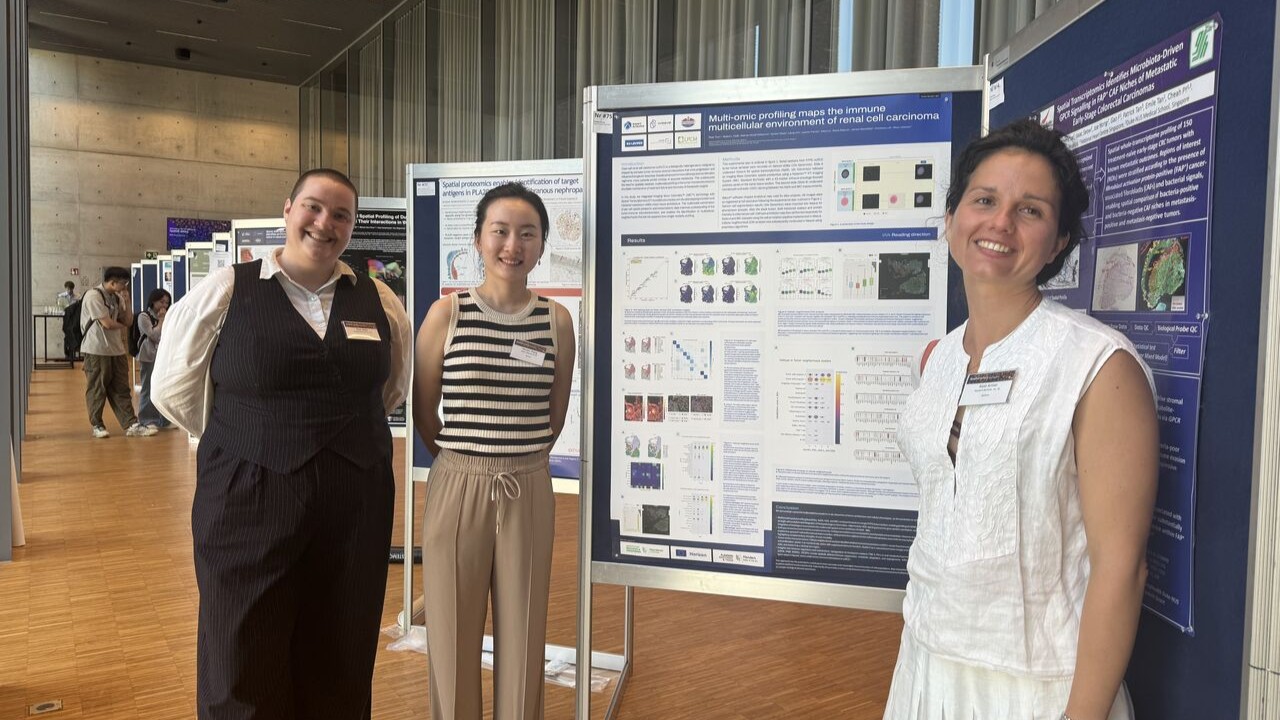
Clear cell renal cell carcinoma (ccRCC) is a heterogeneous cancer shaped by complex tumor-immune-stromal interactions, with many patients showing treatment resistance. This proof-of-concept study with Standard BioTools was presented by Wanqiu Zhang and explored spatially-resolved multimodal profiling of the tumor microenvironment using Weave. By co-registering Xenium 5K spatial transcriptomics, Imaging Mass Cytometry spatial proteomics, and H&E imaging from a single FFPE tissue section, the study achieved gene and protein analysis integrated at the single-cell level. Key findings showed complementary value of transcriptomics and proteomics for cell typing, and identified distinct tumor microenvironments characterised by metabolic suppression, vascularized immune infiltration, and hypoxic immune-evasive regions.
To view this poster, please go here.
Same slide spatially resolved multi-omic profiling identifies an immunosuppressive immune checkpoint niche in nasal polyposis
This poster presents a pilot study on nasal polyps, benign nasal growths affecting 10–15% of the population, using a novel same-slide multimodal imaging approach. The researchers combined CellScape multiplex immunofluorescence and H&E staining, co-registered using Weave, to map immune cell types and spatial niches within polyp tissue. The analysis identified 19 distinct cell types and 20 multicellular environments, revealing pervasive M2 macrophage infiltration and three eosinophil-rich niches. Crucially, PD-L1-expressing macrophages and granulocytes were found in close proximity to PD-1+ T-cells in the polyp stroma, indicating an immunosuppressive checkpoint niche that may help explain why chronic rhinosinusitis with nasal polyps persists despite active immune responses.
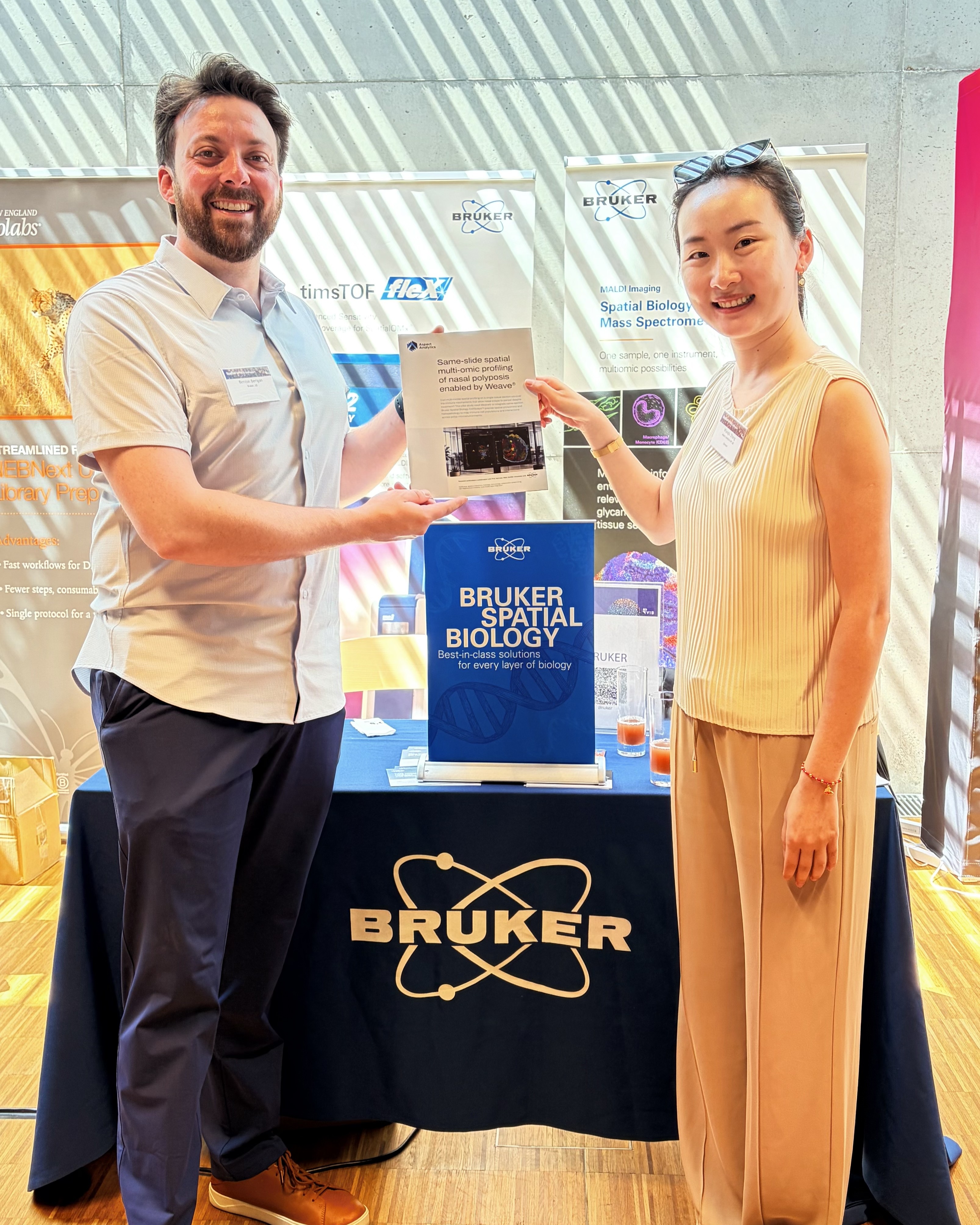
This study is a collaboration with Griffith University and Bruker Spatial Biology.
To view this poster, please go here.
In summary, Aspect Analytics' continued presence at VIB Spatial Omics reflects both the company's growing role in the spatial omics ecosystem and the increasing centrality of data integration tools to the field itself. As spatial datasets grow in complexity, platforms like Weave — designed to bring disparate omics layers together in a coherent, interactive environment — become not just useful but essential.
Contact us if you have questions about the presented studies, want to learn more about Weave, or discuss how we can support your own spatial multi-omics projects.
Images © 2026 Aspect Analytics. All rights reserved.