Recap - NextGen Omics, Spatial & Data US 2026
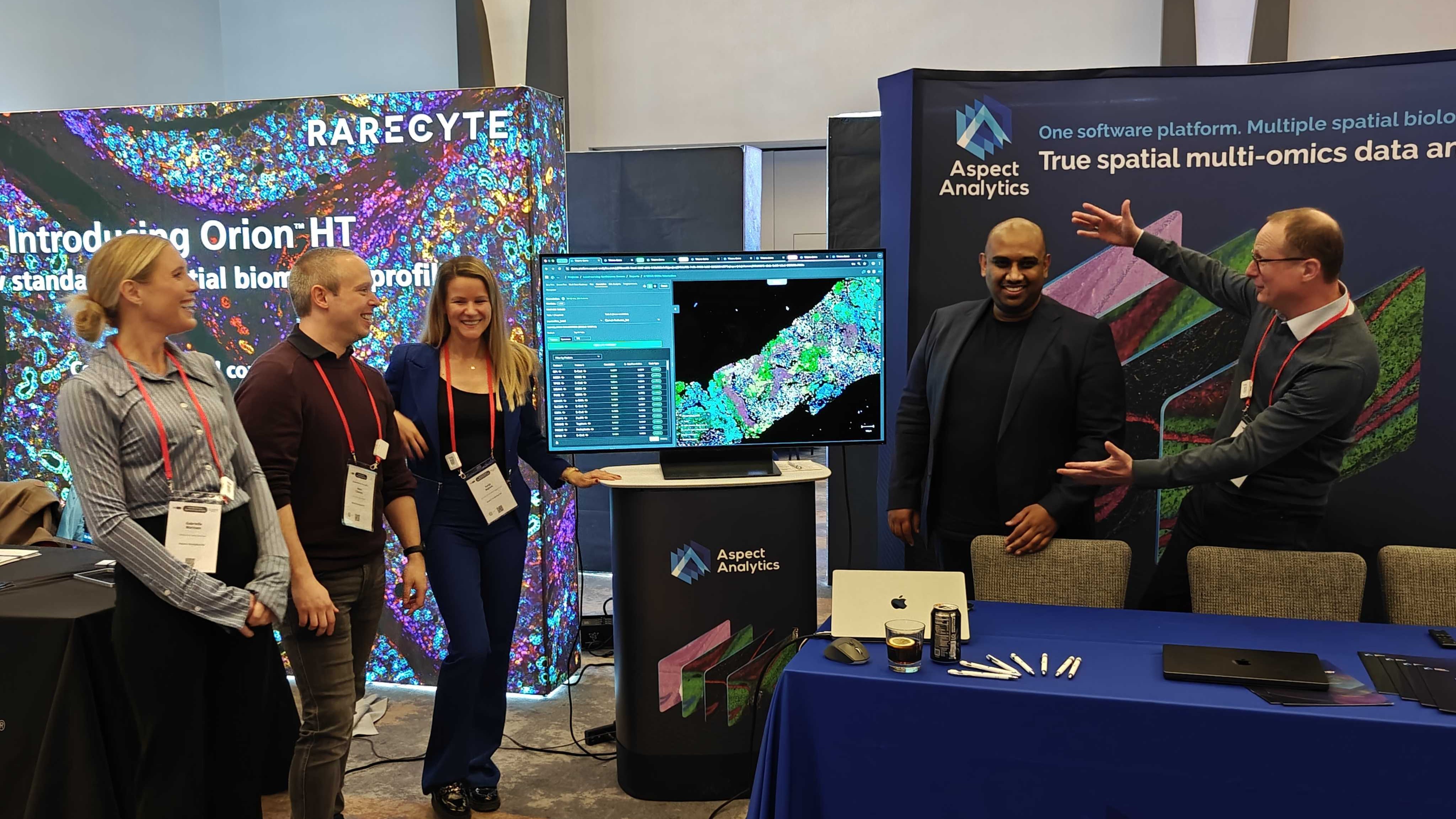
Aspect Analytics attended the NextGen Omics, Spatial & Data US 2026 meeting in Boston, where experts from pharma, biotech, and academia came together to discuss the latest innovations driving multi-omics research from novel technologies to clinical applications.

Aspect Analytics attended the NextGen Omics, Spatial & Data US 2026 meeting in Boston, where experts from pharma, biotech, and academia came together to discuss the latest innovations driving multi-omics research from novel technologies to clinical applications.
Why spatial biology data analysis is now a critical bottleneck
As spatial transcriptomics and spatial proteomics technologies mature, experiments routinely generate tens to hundreds of gigabytes of complex, multimodal data. Analyzing this data, e.g. integrating spatial biology assays with histology, managing quality control across instrument vendors, and enabling team-wide collaboration, remains the primary bottleneck for researchers adopting spatial biology workflows. Several talks at the meeting highlighted how Aspect Analytics' Weave® platform addresses these challenges as an enterprise-grade, cloud-based spatial data analysis platform purpose-built for spatial multi-omics.
Keynote recognition: Aspect Analytics as a leader in spatial biology data analysis

In his opening keynote, Arutha Kulasinghe, the world's first Chair in Spatial Medicine at the University of Queensland, highlighted Aspect Analytics and its Weave platform as a leader in computational spatial biology and AI-driven spatial data analysis. Professor Kulasinghe also visited the Aspect Analytics booth for a hands-on demonstration of Weave's spatial multi-omics capabilities.
Spatial multi-omics in drug discovery: AbbVie's rheumatoid arthritis study analyzed in Weave
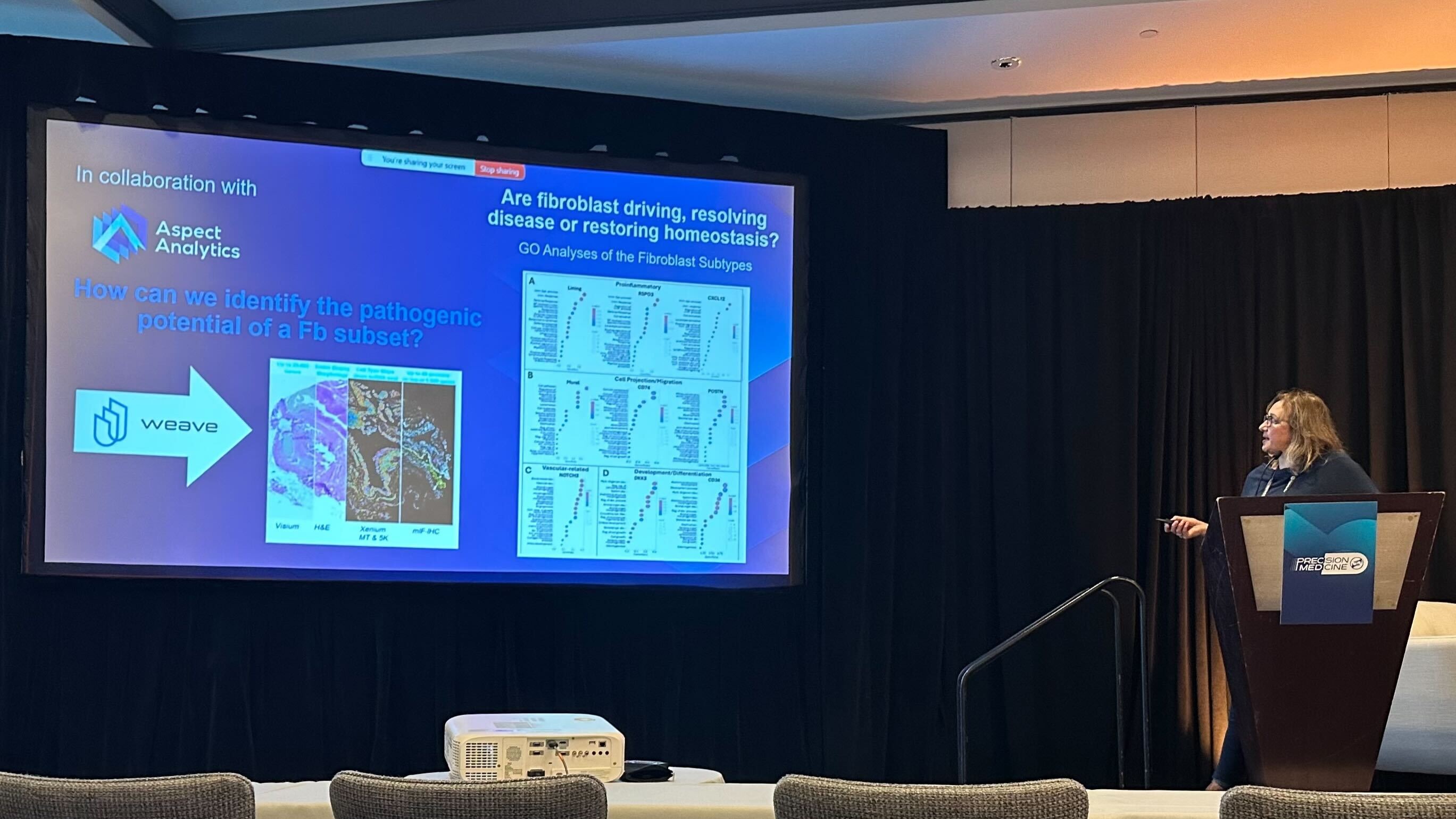
A highlight of the meeting was the Aspect Analytics-sponsored talk by Sílvia Siso, Senior Principal Scientist-Pathologist in AbbVie's Discovery Research Pathology group. In "Multidimensional Spatialomics Empowers Our Understanding Of Rheumatoid Arthritis Pathobiology," Dr. Siso presented a study examining fibroblast spatial organization in rheumatoid arthritis (RA) using Xenium and Visium spatial transcriptomics with histology.
The study revealed a distinct laminar configuration of up to nine fibroblast subtypes in RA synovium, compared to random organization in healthy tissue, suggesting that fibroblast subtypes expand, transition, and maintain organized cellular niches with distinct pathophysiological roles.
Aspect Analytics' Weave platform and bioinformatics team played a critical role in this study by enabling:
- Import, data management, and QC of multiple spatial assay types and instrument vendors within a single cloud-based platform,
- Stack fusion — co-registration and integration of spatial multi-omics datasets for combined downstream data analysis,
- Identification and exploration of fibroblast subtypes and their spatial distribution across recurring cellular neighborhoods, and
- Interdisciplinary collaboration through interactive, multimodal visualizations accessible from web browsers.
This real-world case study demonstrates a key differentiator compared to tools that handle only individual steps or single data modalities: how Weave supports spatial transcriptomics data analysis workflows end-to-end, from raw data import to biological insight.
Large-scale spatial atlas generation with Weave

Jiwoon Park, postdoctoral researcher at Weill Cornell Medicine, presented "Spatial Atlas Generation & Large Scale Data Analysis" in the GESTALT Spatial Biology Workshop. Park described the Spatial Atlas of Human Anatomy (SAHA) initiative, which aims to create high-resolution, multi-omic maps of human organs. Weave was used for alignment of spatial transcriptomics, spatial proteomics, and H&E data, and for analysis of spatial niches within the atlas. This demonstrates the platform's ability to support the scale and complexity required by large atlassing projects.
Key themes: what the spatial biology community needs from data analysis platforms
Conversations across the meeting reinforced several themes central to the future of spatial biology data analysis:
- Spatial technologies are transforming tissue analysis, enabling new approaches to target identification, biomarker discovery, and clinical trial design across therapeutic areas.
- Scalable, collaborative data platforms are becoming essential for translating spatial biology experiments into actionable discoveries, particularly for teams spanning pathology, bioinformatics, and biology.
- Multi-omics integration is expanding disease understanding beyond oncology into inflammatory, autoimmune, and chronic conditions.
- AI and machine learning are increasingly required to extract meaningful insights from the scale and complexity of spatial datasets.
About Aspect Analytics and Weave
Aspect Analytics develops Weave, a cloud-based spatial biology data analysis platform. Weave supports spatial assays (transcriptomics, proteomics, metabolomics, histology etc) from any instrument vendor in a single collaborative environment. It is used by pharma, biotech, and academic teams for applications ranging from biomarker discovery to large-scale tissue atlas construction. Key capabilities include multi-vendor data import, spatial multi-omics data co-registration and integration (stack fusion), AI-powered spatial analysis, interactive browser-based visualization, and enterprise-grade cloud infrastructure.
Reach out if you have questions about any of the studies presented at NextGen Omics, or to discuss how Weave can support your spatial multi-omics projects.
Images © 2026 Aspect Analytics. All rights reserved.