From Raw Data to Real Impact: Why Data Management Is the Backbone of Spatial Biology Research
A friendly guide to keeping your science (and your sanity) intact.
TL;DR: In spatial biology and life sciences research, your data is only as valuable as your ability to understand, trace, and reuse it. This post breaks down the essentials, metadata management (knowing what your data represents), workflow traceability (knowing how it was produced), and FAIR principles (making it findable, accessible, interoperable, and reusable). We also show how Weave builds these into a single, integrated platform so you can focus on the science, not file naming conventions.
If you work in biological research, biomedicine, or pharma, you already know the feeling. A collaborator has sent you a folder filled with files with names like m3_1042-2_100x100_v3.csv, and you must identify which one is relevant to your work. Maybe you've inherited a dataset with no description of how it was generated and spent an afternoon (or two) trying to figure out which data analysis steps were used to produce it. Sound familiar? Let's be honest: nobody chooses the lab life because they're passionate about data management. You're here because you want to understand disease, develop therapies, decode the complexity of living systems. Data management is the boring part.
But here's the thing — data management is the research. Every experiment, every assay, generates information that only has value if it can be understood, trusted, and reused. In an era where a spatial multi-omics study can produce terabytes of raw data and cost thousands of dollars to conduct, keeping track of data is key. Moreover, complex analysis pipelines can produce hundreds of downstream artefacts with intricate links between them, often involving several versions with different variations of results. Without proper bookkeeping, these results risk rotting over time into an unusable mess. If not, consequences ripple outward: duplicated experiments, retracted papers, failed regulatory submissions, and funds wasted.
So let's talk about why thoughtful data management matters and break it down into three areas that deserve your attention: metadata management, workflow traceability, and the FAIR principles.
Metadata Management: The Context That Makes Data Meaningful

Here's a simple truth: raw data without context is just noise. A spreadsheet of numbers or a collection of IHC images doesn't tell you much unless you know what was measured, how, when, by whom, and under what conditions. That contextual layer is metadata, and managing it well is one of the highest-impact things a research team can do.
Weave contains a built-in data management layer that handles the inventory and analysis processes for your spatial biology and adjacent data. In order to capture the metadata belonging to a measurement, Weave provides an extensible data model that is composed out of following objects:
- Donor: this represents the organism from which a sample was taken that will be measured by an assay (e.g. patient, animal).
- Sample: a tissue sample taken from a donor for the purpose of being measured by an assay (typically a core or tissue block).
- Section: a slice taken from a sample. For spatial assays, this represents the actual sample material that is being measured by the assay.
- Assay: this represents the characteristics of an assay used to acquire raw data. It is used in Weave to identify measurements that have the same features and can therefore be meaningfully visualized or processed together. An example is a spatial transcriptomics assay with a specific panel (since the panel defines the contents of the acquisitions performed with this assay).
- Acquisition: this represents a run of an acquisition device (i.e. an instrument) that performs a certain assay.
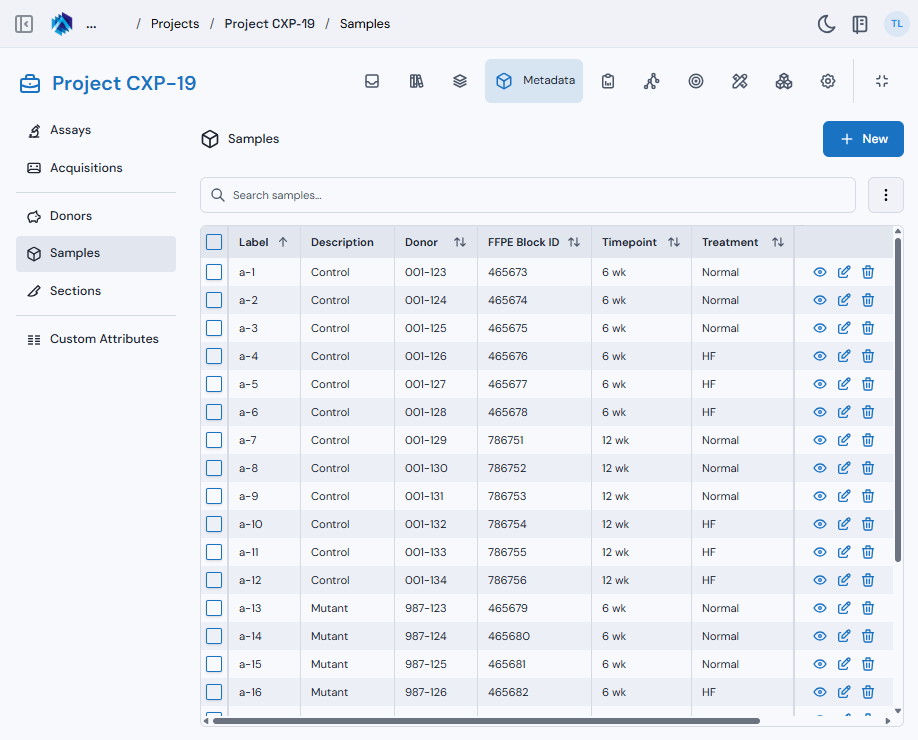
Weave also allows users to flexibly define custom attributes and link to ontologies for each object in the metadata model in order to capture all the useful metadata. These attributes then become available for finding and filtering data assets in Weave.
Workflow Traceability: Knowing How You Got From A to B
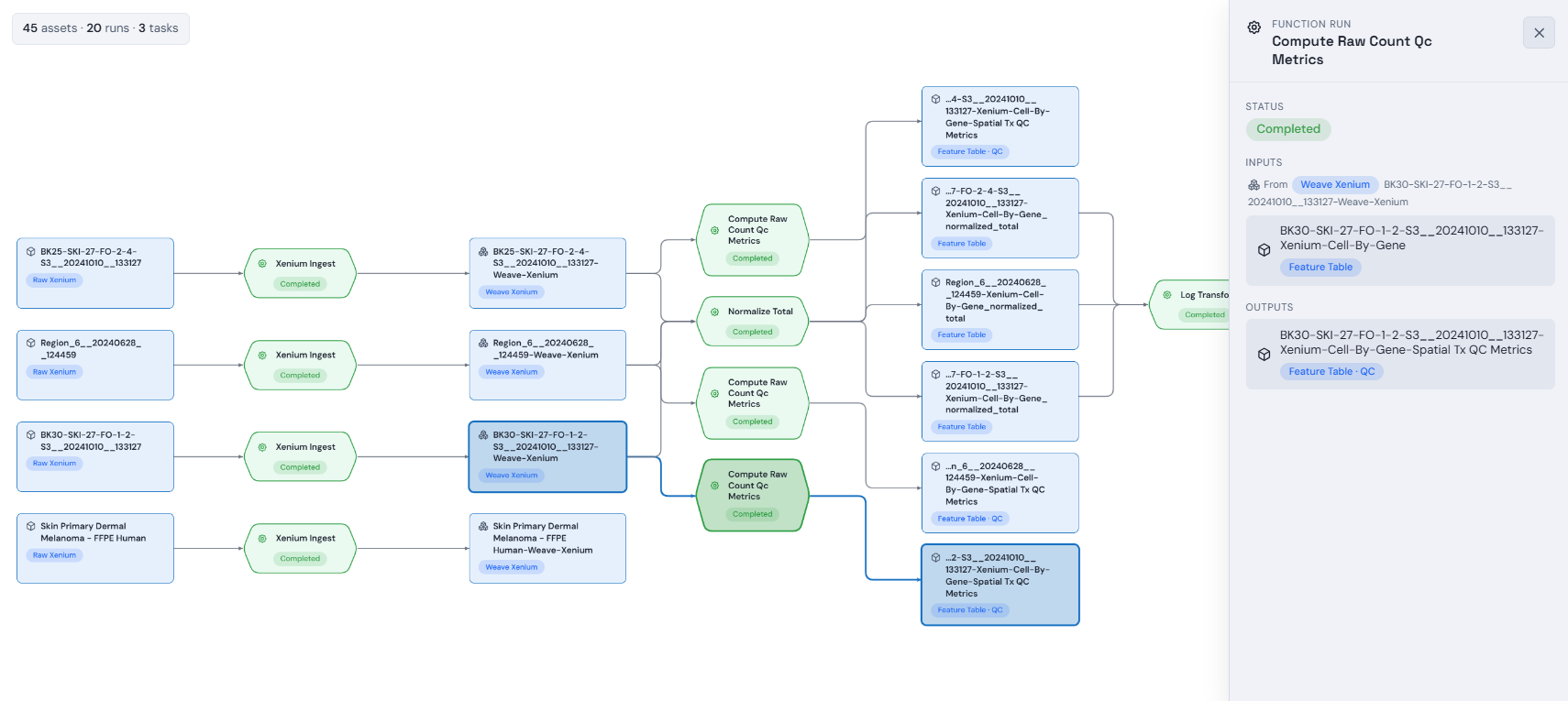
Following on from raw data and how it was acquired, next is knowing how it moved through processing, analysis, and interpretation. Workflow traceability, also known as provenance tracking, is the practice of documenting every step in your data's journey. In pharmaceutical research, traceability is a regulatory requirement. But even outside the regulatory world, traceability matters enormously. Think about the inability to reproduce a collaborator’s figure because a critical preprocessing step was not recorded because they thought it was “obvious” or the staff member who leaves the lab and takes the data analysis pipeline knowledge with them. It is easier to reuse and replicate if you know how things were generated. For many bioinformaticians, the notebook that was used to generate results is treated as the de facto documentation of those results, but often these notebooks do not get stored together, get modified post-hoc or are not shared with all stakeholders. If the code gets lost or out of sync with results, those results lose critical context. Weave's provenance tracking is designed to tackle these types of problems.
While modern tools such as electronic lab notebooks and laboratory information management systems (LIMS) make traceability far more achievable than it used to be, the key is to embed traceability into your daily routines rather than trying to reconstruct it after the fact. In Weave, traceability is baked into the workflow rather than bolted on afterwards.
FAIR Principles: Making Data a Lasting Asset
You've probably encountered the FAIR principles: Findable, Accessible, Interoperable, and Reusable. Coined in 2016, these four principles offer a framework for ensuring that research data delivers value not just to the people who generated it, but to the broader scientific community.
- Findable means data and metadata are easy to locate, both by humans and by machines.
- Accessible means that once someone finds your data, there's a defined process to access it, with appropriate authentication where needed.
- Interoperable means data uses shared vocabularies, formats, and standards so it can be combined meaningfully with other datasets.
- Reusable means data is accompanied by enough metadata and provenance information that others can replicate and/or combine it in new contexts.
FAIR is rapidly becoming an expectation. Many major funding bodies and journals now require or strongly encourage FAIR-aligned data management plans. Adopting FAIR practices benefits your own work as well. Data that is well-organized, well-described, and stored in standard formats is easier to reuse within your own group, easier to integrate across collaborative projects, and far less likely to become an incomprehensible artefact gathering digital dust on a forgotten server. All data sets and downstream analysis results can be published to collaborating projects teams within Weave following FAIR principles with ontology grounding.
What AI Agents in Biology Need From Your Data
A recent article from Anthropic (“Paving the way for agents in biology,” June 2026) offers a striking illustration. When AI agents were tasked with retrieving viral sequences from NCBI Virus, even the strongest models produced wildly inconsistent results — one returned 106 sequences on a first attempt, 15 on a second, and 5 on a third from an identical prompt. The problem was not reasoning; it was infrastructure. Inconsistent metadata, browser-only filtering logic, and no reliable programmatic access meant agents had no dependable path to the data. When a deterministic retrieval tool was added, accuracy across all agents jumped to nearly 100% —and the performance gap between expensive and cheaper models collapsed. Two recent papers presented "AI Scientists", Co-Scientist by Google and Robin by FutureHouse, multi-agent systems using specialized AI agents that can generate hypotheses, propose experiments, interpret the results, and refine hypotheses accordingly. While the results are impressive, the authors noted that these systems are designed to be collaborators with a continued need for human oversight. Agents are phenomenal at interpreting data that exists alongside its contextual metadata and using that for additional downstream analysis. However, if the metadata is absent, ambiguous or incomplete, it is no silver bullet. If the project team cannot unambiguously define what is what from the full project inventory, neither can an agent. In this case, the risk of silent failures in which the agent hallucinates results or confidently make erroneous interpretations dramatically increases. It is exactly these failure modes that can and must be prevented at the source, through well-curated, standardized and documented data inventories.
The Co-Scientist authors proposed improvements included integrating agents that can directly reason over multimodal data, enhanced learning knowledge base capabilities, and implementing more rigorous fact-checking against external databases and tools. In our opinion, knowledge bases, databases and tools should include not just publications but also the accumulated, harmonized institutional data. Consistent metadata schemas, traceable workflows, and FAIR-aligned data are not just good hygiene for human researchers — they are the foundation that makes biological data navigable for agents too.
Bringing It All Together
Metadata management, workflow traceability, and FAIR principles reinforce each other. Rich metadata makes data findable and reusable. Traceable workflows make results reproducible and auditable. FAIR practices ensure that the investment made in generating spatial biology data pays dividends beyond a single publication. In Weave, data management is foundational infrastructure. With built-in metadata management and workflow traceability that adhere to FAIR principles, you're not just tidying up files. You're building a research ecosystem that's more reproducible, more efficient, and ultimately more impactful.
Well-managed research data doesn't just benefit the teams who generate it — it's also exactly what foundation models need to perform well. Large language models and multimodal AI systems are only as good as the data they're trained or fine-tuned on, and that means structured, richly annotated, and traceable datasets. When metadata is consistent and complete, models can learn meaningful relationships between experimental conditions and outcomes rather than picking up noise. When workflow provenance is intact, training data can be filtered by quality, method or processing stage, reducing the risk of models learning from artefacts or irreproducible results. And when data follows FAIR principles, it becomes discoverable and interoperable at scale, dramatically expanding the pool of high-quality training data available across institutions and disciplines. In short, the same practices that make data trustworthy for human researchers make it useful for AI. Organizations that invest in rigorous data management today are building the foundation for more reliable, domain-aware models tomorrow.
But that’s a topic for another blog.