Extraction of the polysorbate 20 and 80 fingerprint via generative modeling
This transforms polysorbate analysis from labor-intensive peak-by-peak workflows into an objective characterization tool suited for quality control, batch selection and degradation monitoring.
Abstract
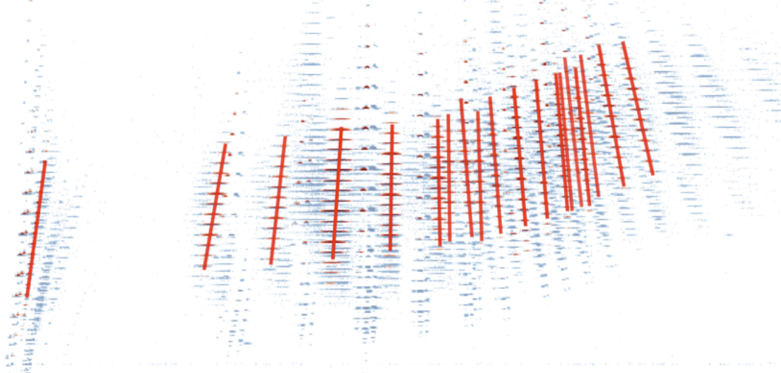
Polysorbate 20 (PS20) and polysorbate 80 (PS80) are essential surfactants used to stabilize biopharmaceutical products, yet their highly heterogeneous mixtures and susceptibility to oxidation and enzymatic hydrolysis complicate routine analysis. The authors developed a hierarchical generative AI model that reconstructs entire liquid chromatography–mass spectrometry (LC–MS) measurements to automatically interpret complex polysorbate datasets. By embedding domain knowledge of base structures, oxyethylene chain lengths, fatty acid esterification, and isotope patterns, the model resolves individual subspecies and provides molecular-level composition.
Takeaways
- Model validated against manual integration: intact/degraded fraction split matched closely (~80% intact for both methods), and S12 (sorbitan monolaurate) abundance extracted by the model lines up with pharmacopoeia and literature values (~20% w/w) — proof the model is accurate, not just elegant.
- Automated vendor/grade fingerprinting: across HP, SR, and CG grades of PS20 and PS80, the model picked up real compositional differences (e.g. CG PS80 almost pure oleic acid, SR with reduced isosorbide, CG with virtually no POE species) without any manual peak hunting — a strong batch-screening/incoming-goods-QC use case.
- Distinguishes oxidative vs. hydrolytic degradation at the molecular level: using forced-degradation samples at four oxidation scores, the model tracked emergence of a "degraded" (short-chain) population per subspecies via a new f_degraded parameter, quantifying degradation severity species-by-species rather than just overall.
- Captured PS80's more complex oxidation chemistry: the model reflected the two-stage oxidation of oleic acid (PS80 → hydroxyl intermediate → bimodal shorter chains), something simpler peak-based methods can't resolve.
- Non-intuitive mechanistic finding: despite PS80 being generally considered more oxidation-prone, PS20 generated the universal "POE-peroxide" marker faster at moderate oxidation scores — attributed to PS20's simpler 2-step oxidation pathway vs. PS80's 3-step pathway. A genuinely novel insight, good for credibility with a scientific audience.
- Root-cause differentiation in a real antibody system: using mAb1 (with co-purified hydrolytic host cell proteins) vs. placebo, hydrolysis caused a uniform intensity drop while oxidation caused a shift toward short-chain POE12 species — a clean, visual demonstration of distinguishing degradation pathways
Conclusion
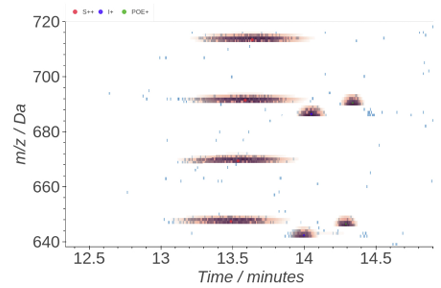
The generative AI model successfully extracts molecular-level fingerprints of polysorbate samples through automated statistical analysis, removing the need for manual LC-MS interpretation. It cleanly separates individual subspecies even with heavy co-elution, avoiding the misinterpretation risk inherent to manual methods.
The study shows the model can characterize PS20 and PS80 down to the subspecies level and differentiate vendor/quality variations, supporting selection of polysorbate batches with more favorable particle-formation properties. By modeling at the molecular level and incorporating bimodal OE distributions, the approach also distinguishes oxidative from hydrolytic degradation pathways — particularly valuable for PS20, where no new oxidation species appear — and for PS80, established literature oxidation markers were incorporated for the same purpose. The addition of the universal POE-peroxide marker further enables direct comparison of oxidative states between PS80 and PS20.
Overall, the model offers four key advantages: automated extraction of precise molecular fingerprints, accurate species-level differentiation validated against manual integration, fast polysorbate quality assessment, and straightforward identification of the responsible degradation pathway
Do not hesitate to contact us if you are interested in learning more about this or have similar workflow needs.
Peter Roelantsa, Reza Ranjbar Choubeha, Nico Verbeecka,*, Rabindranath Andujara, Torsten Schultz-Fademrechtb, Patrick Garidelb,*, Viktor Grossb,*
a. Aspect Analytics NV, C-mine 12, 3600 Genk, Belgium
b. Boehringer Ingelheim Pharma GmbH & Co. KG, Innovation Unit, PDB-TIP, Birkendorfer Straße 65, Biberach an der Riss, 88397, Germany
*Corresponding authors. E-mail addresses: nico.verbeeck@aspect-analytics.com (N. Verbeeck)
Extraction of the polysorbate 20 and 80 fingerprint via generative modeling,
International Journal of Pharmaceutics: X, Volume 10, 2025, 100433, ISSN 2590-1567,
https://doi.org/10.1016/j.ijpx.2025.100433.