AACR 2026 Recap: Spatial Biology Takes Center Stage in Cancer Research
At AACR 2026 in San Diego, spatial biology emerged as a defining force in oncology research. Multi-modal, multi-omic, and multi-sample profiling of the tumor microenvironment — measuring where cells sit, not just what they express — is moving from niche method to standard practice.
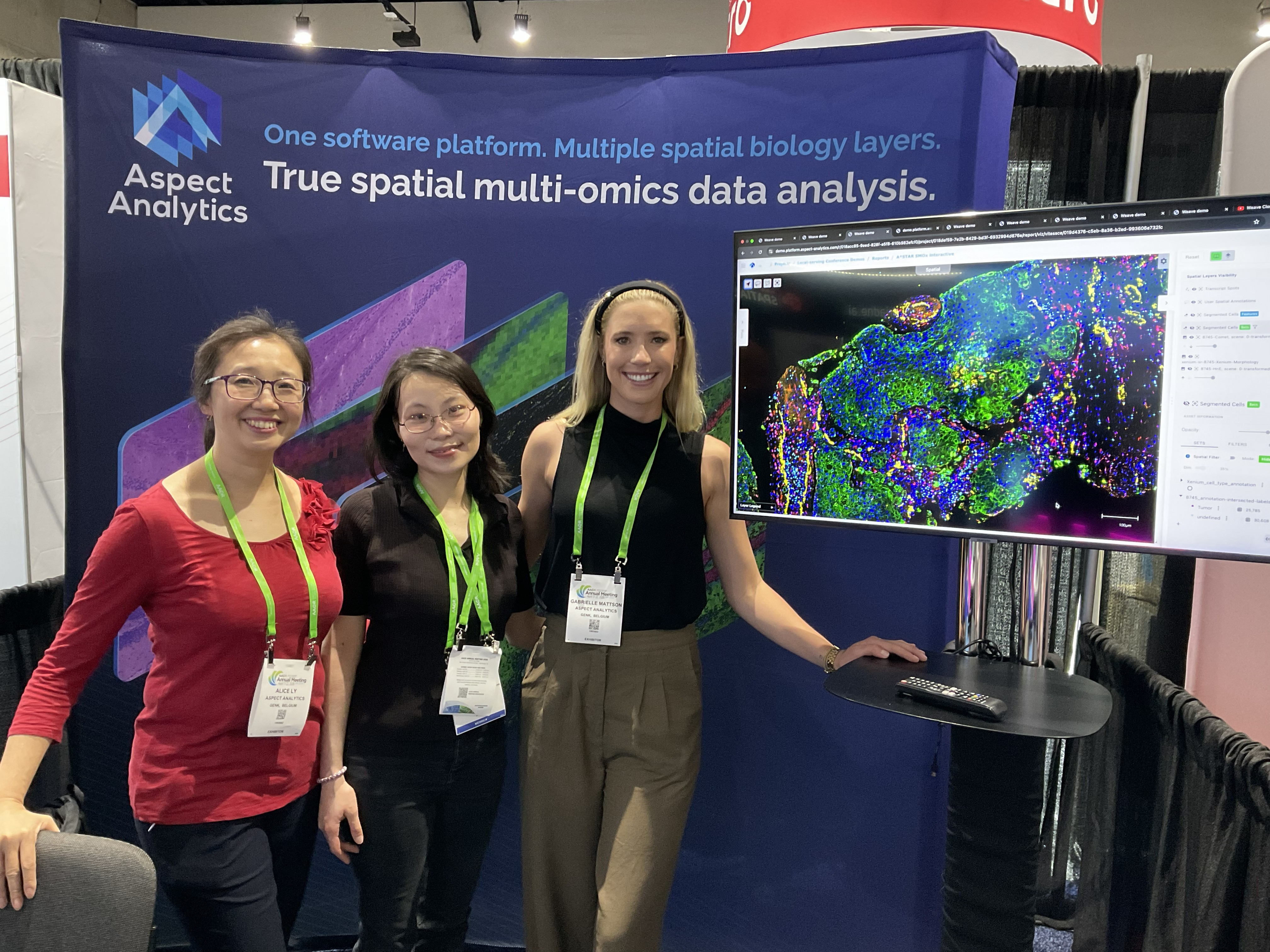
Aspect Analytics attended the American Association for Cancer Research (AACR) Annual Meeting 2026, which brought together more than 20,000 oncology researchers from academia, pharma, and biotech. Across the scientific program, discussion groups, and product presentations, one theme stood out: spatial biology is reshaping how cancer is studied, and understanding where a cell sits now matters as much as what it expresses.
What were the main spatial biology trends at AACR 2026?
- Spatial biology is scaling up. Studies are moving beyond single samples toward cohort-scale designs that address mechanistic and clinical questions.
- Multimodal profiling is the new norm. Combining spatial assays gives a holistic view of tumor biology and reveals tumor–immune microenvironment features invisible to single-modality methods.
- More measurements per section. The field is converging on measuring as many analytes as possible from the same physical tissue section.
- Cellular neighborhoods are getting sophisticated. Researchers increasingly ask which cells co-exist, whether those combinations recur across tissue, and how they link to phenotype.
Our AACR 2026 poster: mapping the immune environment of renal cell carcinoma
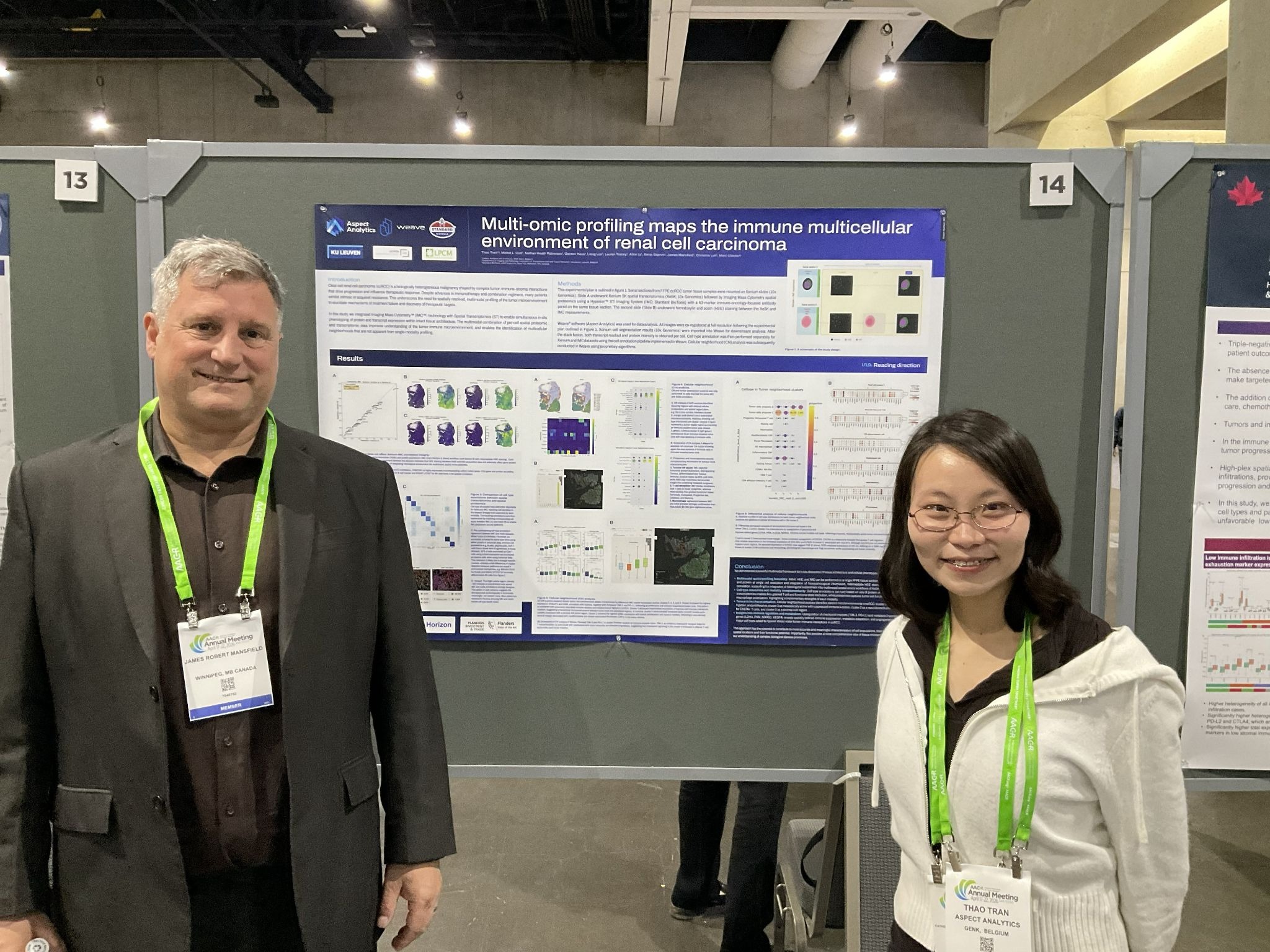
These themes anchored our poster, “Multi-omic profiling maps the immune multicellular environment of renal cell carcinoma.” Clear cell renal cell carcinoma (ccRCC) is a heterogeneous malignancy shaped by complex tumor–immune–stromal interactions, and many patients show intrinsic or acquired resistance despite advances in immunotherapy. Spatially-resolved multimodal profiling of the tumor microenvironment (TME) can help elucidate mechanisms of treatment failure and surface new therapeutic targets. This proof-of-concept study, in collaboration with Standard BioTools Inc., tested multimodal profiling from a single tissue section.
How does Weave® enable multimodal spatial analysis?
Weave® provides a cloud-based multimodal framework for dissecting tissue architecture and cellular phenotypes. In this study it was used to:
- Import, co-register, and fuse Xenium 5K spatial transcriptomics (10x Genomics), Imaging Mass Cytometry™ spatial proteomics (IMC™; Standard BioTools), and H&E whole-slide images on one platform.
- Apply the Xenium cell segmentation mask as a spatial footprint, yielding integrated gene and protein expression within the same cells.
- Compare cell type annotations from spatial transcriptomics versus spatial proteomics.
- Run Cell Neighborhood (CN) analysis to find recurring regions of cell composition and spatial organization, with downstream statistical and bioinformatics analysis.
What did the study find?
- Xenium, H&E, and IMC can be run on a single FFPE section, enabling single-cell resolution profiling of mRNA and protein, and integration of histopathological information.
- Gene–protein correlation is unaffected by intermediate H&E staining.
- Cell type annotations vary by modality: transcriptomics resolves fine-grained T cell states, while proteomics captures tumor cell functional states and confirms macrophage polarization.
- CN analysis identified distinct ccRCC microenvironments in our samples: one metabolically active with suppressed immunity, one a vascularized margin enriched for CXCR4+ T cells, one stromal-rich region, and one immune-evasive, hypoxic, and proliferative.
- Upregulated checkpoint markers and metabolic/hypoxia genes in specific CNs reveal spatially defined immune suppression, metabolic adaptation, and angiogenesis.
View the full poster here.
The bottom line
AACR 2026 confirmed that multi-modal spatial approaches are coming of age. Together they offer a clearer window into the biology of tumor-associated neighborhoods and the mechanisms behind treatment response and resistance.
Have questions about the study, want to learn more about Weave®, or want to discuss your own spatial multi-omics projects? Contact our team.
Images © 2026 Aspect Analytics. All rights reserved